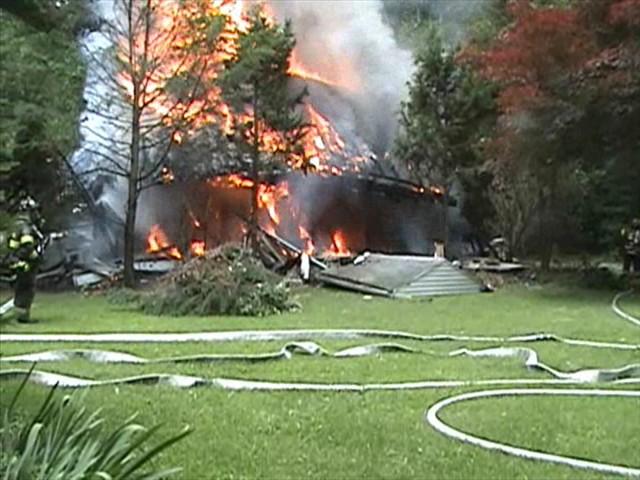
In September 2009, a local volunteer fire company let a home in Obion County, Tennessee, burn to the ground because the owner had failed to pay his annual fee of $75 for fire protection. Said the community's mayor, "If homeowners don't pay, they're out of luck." That incident has become a folklore tale in volunteer fire companies around the nation but Marc Crusemire, president of East Brandywine Fire Company, insists it never will happen here. The volunteers will be there if a fire breaks out whether or not a resident sends a contribution during the Company's annual fund drive. But Mr. Crusemire wishes more residents would send cash. Last year, 1,350 residents gave financial support; 3,050 did not.
The service area covers all of East Brandywine, about two-thirds of West Brandywine and a small slice of Upper Uwchlan. In a typical year, the Company handles about 300 fire calls and more than 450 emergency calls to cover accidents or illnesses. People unfamiliar with volunteer fire companies often don't realize just what that means—namely that the 25 to 30 active members of the company work for no pay. Yet the Fire Company's operating costs total close to $350,000 a year. Where does the money come from? The fund drive brings in about $90,000. East Brandywine Township contributes around $70,000, West Brandywine about $45,000 and Upper Uwchlan a much smaller amount (the two parties are trying to reach agreement on a fair contribution; Upper Uwchlan officials want to base it on the number of calls; the Fire Company says that's an unrealistic measure since it has to maintain a wide range of equipment no matter how many calls it answers).
The Fire Company raises much of the other cash it needs from its various non-fire activities—renting out its banquet hall, an annual chicken barbecue, offering birthday parties and the proceeds (after expenses) from its Kids Festival. To put the East Brandywine contribution into perspective, consider that the Township this year will commit about 37% of its total income for police protection and about 1.5% for fire protection.
Operating expenses are only one part of the Fire Company's budget. It also has to plan for capital expenditures and these can be huge. For example, it will need to replace its ladder truck in the near future at a cost of between $750,000 and $1,000,000. Other high-dollar replacements will soon be needed. There's also the cost of safety equipment. Recently, the company paid $125,000 to replace 18 air packs and masks. It costs about $3,000 just to buy each firefighter's protective gear—coat, helmet, gloves and boots. Mr. Crusemire said the Fire Company is setting aside about $124,000 a year toward future capital expenses within his current budget. "We will have a balanced budget again in 2011," he says."We won't spend more than we have." But he yearns for a consistent source of new revenue. "We absolutely need a fire tax," he says, repeating a wish of many years by various Fire Company officers. Under state law, a municipality may levy a fire tax of up to 3 mills. The current East Brandywine real estate tax is 2.75 mills.
He also likes to stress that beyond its emergency services, the Fire Company is a business. In addition to money, it needs talents not related to firefighting, he says. He ticks off a list of possible volunteers that includes accountants, contractors with useful contacts, people who could help with kids' events and fundraisers. "I'd love to have a grant committee of two or three members who could help us get money from the state or federal governments, or from other funding sources."
Members of the Fire Company truly are a tight-knit band of brothers (and sisters). Their training calls for a fire course of 140 hours and a weekly Wednesday night training session. Members obviously enjoy the camaraderie of coffee and bull sessions. They have to be on call 24 hours a day—though night shifts are scheduled to give some time off the clock. Enough members live and/or work close enough to the fire hall that Mr. Crusemire figures the fire equipment can be manned and rolling within four minutes of getting an emergency call.
Much of the Fire Company's non-emergency work centers on young people. The company runs regular fire safety courses at four elementary schools and hosts an annual open house at the fire hall that draws scores of enthusiastic school kids. There they get to marvel at and climb in and out of the fire equipment and examine the many pieces of specialized fire fighting tools (in an amazing commitment to housekeeping, each and every piece of equipment and every tool is kept in spotless condition).
Kids also are the focus of the annual Kids Festival held in Community Park (this year the date is June 11). The Festival, with its park-full of slides, climbing walls, bounce rooms and other entertainment is a major draw, attracting well over 1,000 visitors. What the partygoers don't see is the behind-the-scenes work. Planning for the 2011 event already is well advanced and when June rolls around it will take some 120 workers more than two days to put all the amusement sites in place. This does not include the many hours calling on sponsors to help finance the project. Similarly, the Fire Company's barbecue is a time-draining experience. It takes days to arrange and set up and the event itself takes about 12 to 15 hours of work for each of the volunteers.
The birthday parties at the fire hall, started in 2009, also call for many work hours. There were about 12 parties in 2010 and the Fire Company hopes to add to that number this year. In the early days, donations ran from $100 to $400 for each party; this year "we'll probably be asking for $200 to $250 per party," says Mr. Crusemire. The number of children at the parties varies but has totaled as many as 30. The day's features include a talk on fire safety, checking out the equipment and a visit from Sparky (a firefighter dressed in full equipment) and Freddie, the little robot fire plug who toots and whistles and carries on conversations with the kids (a big favorite who's also featured at school fire safety days). For now, people bring their own food and drink. A large party generally calls for five or six supervising adults. "We're always looking for additional help," says Mr. Crusemire.
In another tip of the hat to young people, the Fire Company recently lowered the age for junior firefighters from 16 to 14. These young members learn the basics of the job and work on many projects around the fire hall. The hope is that, in time, they will become full firefighting members.
Looming over all other issues are the long-term questions of whether or not the Fire Company can continue as an all-volunteer organization and the adequacy of its present headquarters on Bondsville Road. At the moment, the volunteer status seems secure although the time may come when, as has happened elsewhere in the region, the company hires one or two full-time officers. Scott Piersol, who in addition to being the Township Manager and Fire Marshall is also Treasurer of the Fire Company, estimated three years ago that a full-time, paid fire department would cost the community more than $1,000,000 a year.
The present fire hall has limitations. It has no bunkroom so firefighters who have to spend the night there sleeping on temporary cots or in sleeping bags placed on the floor. There is little office space or privacy. And if the present ladder truck, with a 75-ft. ladder, is replaced with a 100-ft. model— something the Fire Company wants—it won't fit in the existing building. The Fire Company did bring the accommodations issue to the Board of Supervisors a couple of years ago and suggested a possible move to a new site on Horseshoe Pike. The Supervisors asked for a plan identifying the best future options. "We want to do what's best for the Township and the company," says Mr. Crusemire. "We have to study our options, consider how much debt to take on. We've got to be fiscally responsible. We want to lay the groundwork for future generations."
*Reprinted with permission of East Brandywine Township - The Milemarker Winter 2011 |





 Add a Comment